What You Won't Get at the Krav-Maga Camp — and What You Will
Over the past few weeks I have written about what authentic preparation for surviving aggression really means. About the difference between fighting and surviving. About the fact that the goal is not victory, but minimizing losses. About how a grain of rice doubled 64 times surpasses the world's entire rice production — and how the same principle applies to every training session.
Reading all of this, a skeptical voice in your mind may have said: "Sounds interesting. But what's the catch?"
It is a question that is not just valid, but necessary. The self-defense course market — through Krav-Maga or other approaches — is full of promises. From the outside, they seem realistic and attractive. The problem is that from the outside, you have no way to evaluate them objectively — you have no suitable frame of reference. Even if you have a background in other martial arts or combat sports.
Any technique can be presented in contexts where it works. Guess what you're usually shown? Demonstrations in which a capable instructor performs on a physically weaker and less technically prepared student. Controlled, favorable contexts that have nothing to do with a real conflict — with an attacker who is stronger, faster, or more determined than you.
I am not interested in what an instructor can do to a student. I am interested in what chance the weakest student has against the strongest attacker. That is the real question. And it is around that question that I build my entire approach.
So, to be completely transparent, let me start by telling you what you will not receive at the Krav-Maga camps I am teaching in July and August.
What you won't get
You won't get the promise of invincibility. If that is what you're looking for, I'll tell you directly: it doesn't exist. No system, no instructor, no number of training hours transforms you into someone impossible to harm. The person who attacks you always starts with an advantage — they chose the moment, the place, and the method. Any instructor who promises otherwise either doesn't understand real violence or is selling you a comfortable illusion.
You won't get spectacular, complex, or aesthetic techniques. Authentic Krav-Maga doesn't look good in videos. There are no jumps, spins, or long combinations to film and post. There are simple, direct movements, designed to work when you are surprised, when your pulse is at 180 beats per minute, and when your brain no longer has access to anything complicated. Simplicity is not a flaw. It is the core principle.
You won't get a lot of theory and little practice. Conceptual knowledge of a technique doesn't help you in the critical moment. What matters is the reflex — and reflexes are built only through repetition under pressure, not through slides and explanations.
You won't get pure practice with no theory either. The probability of applying techniques in reality exactly as in training is minimal. So you need to become capable of adapting and improvising. And for that you need to understand, not just know. You need principles more than techniques.
You won't get a comfortable, stress-free environment. Authentic training for real violence is uncomfortable by definition. You will work with fatigue, with controlled chaos, with scenarios that push you out of your comfort zone. Not because I enjoy complicating things, but because controlled stress in training is the only way to prepare your brain and body for real stress.
You won't get false confidence. An honest course in surviving aggression will never tell you that you are now ready for anything. It will tell you what you can do, what you cannot do, and where the limits of what you have learned lie. That clarity is more valuable than any feeling of invincibility.
What you will get instead
You will get a real foundation — not techniques taken out of context, but a coherent system that covers the entire process: from recognizing pre-attack signs, through de-escalation, to physical intervention and its consequences. Surviving an aggression does not begin when you are hit. It begins long before.
You will get real progressive pressure. There is a fundamental difference between repeating a technique on a cooperative partner and executing it when someone is genuinely trying to control you. Feedback — live resistance, scenarios with variables, intentional chaos — is what transforms a movement from something you know into something you do without thinking.
You will get mental and emotional clarity. Under adrenaline, your brain functions differently. It loses access to fine motor movements, to complex decisions, to the procedural memory you built through training. I work explicitly with this reality — we don't ignore it, we train it. You will understand how you react under pressure and build responses that work precisely in that moment.
You will get 7 days of intensive accumulation — something individual courses cannot produce. A weekend gives you a starting point. A series of monthly courses gives you progress. But 7 consecutive days, with 5 hours of daily training, produce a qualitatively different leap: movements cross the threshold from knowledge to reflex. You learn not just the technique, but the context in which it works. You work with fear and stress until your response becomes different.
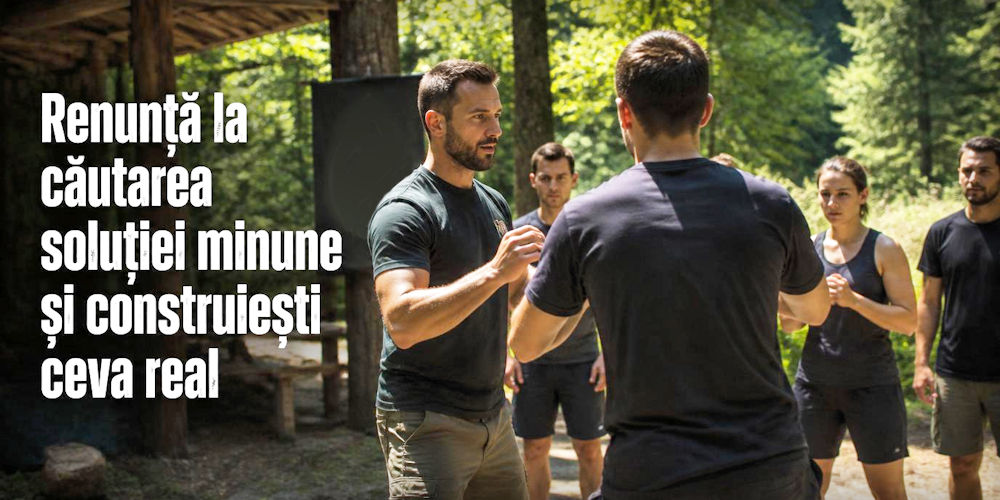
You will get a small group and a human environment. A maximum of 16 participants, in a natural, secluded, and peaceful setting, with meals cooked together and evenings around the campfire. This is not a decorative detail. The quality of learning in a small group is incomparable to that in a crowded hall. You have real access to the instructor, real time to process, and a context in which growth is not only physical.
You will get a real statistical advantage over the vast majority of potential attackers. Not a guarantee — there are no guarantees in real situations. But a significant shift in probabilities. From zero reaction to calibrated response. From panic to decision. From chosen victim to difficult target.
Who this camp is for — and who it isn't
The camp is right for you if you are willing to work seriously, to step outside your comfort zone, and to treat preparation for survival as a real investment in yourself — not as a weekend hobby or a box to tick on a list of things tried.
It is suitable for both beginners and those with experience in martial arts or combat sports. In fact, I have observed over the years that people without prior training often adapt more quickly — they have no established patterns to unlearn.
It is not right for you if you come to collect interesting techniques to show others. It is not right if you need to be convinced from one session to the next that it is worth continuing. And it is not right if your goal is to win fights — but if your goal is to not need to fight, and to survive if you have no choice.
You don't have to take my word for it
I have over 23 years of experience teaching Krav-Maga. I am the first certified instructor in Romania, trained in the original approach to Krav-Maga as a martial art. I have worked with beginners, advanced athletes, women who have been through real situations of aggression, corporations, and parents who want to prepare their children.
I know what works and what doesn't. And that is precisely why I don't promise more than I can deliver.
What I do promise is that you will leave the camp better prepared than when you arrived — not with the illusion of invincibility, but with real tools, real reflexes, and a clear understanding of what you can do and how. That is the difference between authentic preparation and what the market usually sells.
Invitation
I invite you to participate in the next courses that I will teach. To find out about them early, subscribe to our email newsletter. You will also receive interesting articles about surviving aggression. You can also find us on Facebook, Youtube, TikTok and Instagram.
Stay aware and live safely!
László Pethő
Instructor, therapist and mentor
First Krav-Maga instructor in Romania