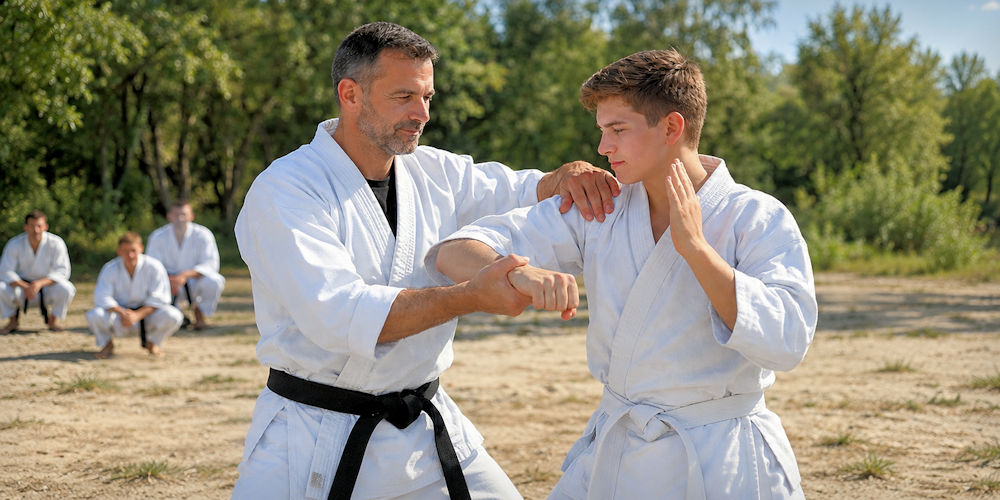
Why I Asked a Mother to Wait a Few More Months
A few days ago I got a call from a mother. She wanted to enroll her teenage son in my classes. I told her the next beginner series doesn't start for almost five months, in January. There was a short pause, then she told me what was really on her mind: she wanted him to start sooner, and over the past few weeks she'd seen ads for several courses starting this very month, in September. She asked me to help her choose one, since she couldn't tell the difference between them — especially since they all seemed to be talking about the same thing: self-defense.
I told her it wasn't that simple. That "self-defense" has become, in recent years, a very broad umbrella covering extremely different approaches. And that before choosing a course, it would help to decide what she actually wanted her son to develop — physically, emotionally, and as a person. If she finds an approach that matches that answer, she can start right away. If she chooses the way I teach, it would be better to wait a few months — because measured against the years of training ahead, five months are insignificant. And a teenager's direction of development deserves a choice made carefully, not out of urgency.
That conversation confirmed to me, once again, how few people know what they're actually buying when they choose a "self-defense" course — and how much the reason for choosing it matters. This mother wasn't afraid. She wasn't coming from an emergency, an incident, a specific fear. She simply wanted her son to grow up more prepared for life. That's exactly the right reason to start — and that's exactly what this article is about.
A Label Too Broad for a Reality Too Diverse
Every September, ads for "self-defense" courses multiply, for adults and children alike. Nearly everyone teaching a martial art or a contact sport advertises their classes under this label.
This isn't new. Thirty years ago, "karate" was used for almost any martial art. If you asked "What does Johnny practice?", the answer from family and friends was almost always "Karate." You had to ask Johnny himself to get the real answer: shotokan, kyokushin, judo, and so on.
Something similar is happening today with "self-defense." On one hand, most people don't know the real differences between martial arts styles and contact sports, so they lump them all together. On the other hand, many instructors use the term as a marketing strategy — selling a perceived benefit, not a specific approach with its own limits and character.
Every martial art and every contact sport was created for a specific context. Most martial arts emerged as survival methods in wartime contexts, mainly in Asia. Once effective firearms spread, their practical importance declined, even in their countries of origin — and they gradually shifted toward art and performance rather than effectiveness in a life-or-death confrontation. Their spread into Western culture accelerated that shift: more and more became sports, with competition rules that ban precisely the most dangerous — and therefore most effective — elements.
Contact sports, in turn, were created specifically for competition. Many people believe a hard-fought match reflects the reality of a street attack. It's a comforting illusion — but an illusion nonetheless. The physical condition, techniques, and mindset built in the ring offer real advantages — but those same advantages become liabilities when an attacker doesn't respect any "sporting" rules. Illegal strikes, throws onto hard surfaces, joint attacks outside the rules, weapons, multiple attackers, plus the surprise of the attack itself — all of these are traps for someone who never accounted for them in training.
None of this means martial arts or contact sports aren't worth practicing. Each offers real value: physical development, fast reflexes, effectiveness within the context they were built for. And each can build important character traits — resilience, confidence, self-control. But just as a boxer isn't prepared to enter a judo competition, and a judoka isn't prepared for a kyokushin match, none of them is actually preparing for a real assault. An assault where anything is allowed and there's no referee. Where there are no weight classes or experience brackets. Where the outcome isn't measured in points, but in days of hospitalization. Where you don't step onto a podium — you either make it home safely, or you don't.
Anyone who wants to develop in a specific martial art or contact sport is free to do so — but they deserve to know exactly what they're training for. And anyone genuinely seeking preparation for real-life aggression should learn to tell the difference between marketing and reality.
Why I Stopped Using the Term "Self-Defense"
A few years ago I stopped describing my courses as "self-defense." The reason isn't cosmetic — it's fundamental: the term doesn't match how I understand conflict.
"Defending yourself" implies a defensive posture — you wait for the blow, then react. The reality is that I want my students to be proactive, not reactive. For us, Krav-Maga is the art of recognizing an aggression early, defusing it when possible, and — when there's no other way — stopping it effectively, whether it comes as a strike, a weapon, or multiple attackers at once. That's why I prefer the term "aggression survival": it doesn't describe a passive reaction, but a conscious choice to replace a victim mindset with a survivor mindset.
Krav-Maga remains one of the very few approaches in the world designed specifically for real aggression, not competition or art. Everything banned in other martial arts and contact sports is prioritized here — precisely because it was banned for being too effective. A sporting match has to last, follow rules, and limit serious injury. A real assault has none of those constraints.
Even within Krav-Maga itself, there are two extremes worth avoiding. One puts all its emphasis on aggression and speed, with no real concern for correct technique — students trained this way don't know their craft well enough and lack self-control. The other puts all its emphasis on technical correctness, drilled endlessly under predictable conditions — students trained this way become prisoners of their own technique, unable to adapt when reality doesn't follow the rehearsed pattern.
At Krav-Maga Stability in Motion, I teach the techniques correctly, because they provide a solid foundation. But I train just as much in simulated aggressions, made progressively more random and chaotic. Without a foundation, chaos becomes overwhelming. Without chaos, the foundation stays theoretical. My students aren't necessarily the strongest, fastest, or most technical — and in Krav-Maga, they don't need to be, because we start from the premise that the attacker may outmatch us on all those fronts. What I aim for is that they have the right approach and the ability to adapt to any new or unfamiliar situation — not memorizing a hundred fixed scenarios, but learning to find solutions for the endless variations a real conflict can bring.
The Same Competence, Beyond the Street
This brings me to the part that conversation with the teenager's mother reminded me of most clearly: the reason you choose to train matters as much as the method.
Many people look for a "self-defense" course out of a specific fear — a recent incident, a news story, a vague worry about personal or family safety. It's a valid motivation, but a limited one: it fades as soon as the fear does, and training becomes, over time, optional.
The mother in the story above wasn't calling from an emergency. Nothing specific had happened. She simply wanted her son to grow more capable of facing life — not just a possible physical attack on the street, but also the smaller, more frequent conflicts he faces daily: an argument between friends, peer pressure, a moment when he needs to say "no" without being intimidated. That's the essential difference between training out of fear and training for growth.
Because, at their core, the principles are the same — whether we're talking about a physical conflict on the street with a stranger, or an emotional conflict at home with a family member. Recognizing early tension that's escalating. Staying in control of yourself under pressure, instead of reacting impulsively. Choosing the right moment and the right way to intervene, without being ruled by fear or anger. Physical or emotional, minor or serious, with a stranger or with someone close — the underlying mechanism is identical.
Physical training is the place where these principles can be tested honestly. Under real physical pressure, you can't fake your inner state — fear, hesitation, lack of control surface immediately, no matter how composed you believe yourself to be in everyday life. That's why what happens in the training hall doesn't stay in the training hall. A teenager who learns to stay calm and clear-headed when someone physically attacks him is, in fact, training the exact same muscle he needs when he's confronted, pressured, or provoked emotionally — at school, at home, among friends. And a community — a family, a group of friends, a neighborhood — can't truly live in peace unless its members have the competence to properly manage aggression, in all its forms, not just the physical one.
So the next time you see the word "self-defense" in an ad — including one of mine — it's worth asking what's actually behind it: personal development, competition wins, or real preparation for the endless variations of conflict? What does the training emphasize: mechanically repeated techniques, rule-bound sparring, or the simulation of real situations? And, above all, what brings you there: fear of something specific, or the desire to become more prepared, in every area of your life?
"I don't promise that life will become easier. I promise that you will become more prepared for it." László Pethő
What You Can Do Now
The next Krav-Maga for Beginners — Yellow Belt series, in weekend format with seven monthly modules, starts in January 16th, 2027. It's designed for those who want to begin with the right foundations: recognizing and avoiding conflict, then neutralizing it through fundamental techniques, practiced progressively closer to the chaos of a real situation.
If the story of the mother and her son sounded familiar — whether you see yourself as a parent looking for the right direction for your child, or as an adult who feels it's time to invest in your own preparation — five months isn't an obstacle. It's enough time to decide with clarity, not in a rush.
Subscribe to the email updates to be the first to know when registration opens for the January series, and whether an intensive course appears before then. Or, if you already know you want to be part of the founding group, enroll now — spots are limited.
Stay aware and live safely!
László Pethő
Instructor, therapist, and mentor
Romania's first Krav-Maga instructor