This article was inspired by feedback received from one of the participants in the last Women's Assault Survival course I taught in March:
"I think it's important to become aware of what would motivate us to defend ourselves vigorously, especially if we are women with a calm and gentle temperament. I thought about this right after the course and concluded that, for me, it would work either through a sense of justice — I dislike unfairness and abuse — or through the idea of not letting men feel superior to women. This clarity helped me — otherwise I would have been left thinking I'm too weak and incapable of defending myself firmly."
A simple piece of feedback, but one that touches something essential: the motivation to defend yourself is neither universal nor always present. And if you don't identify it, the techniques you've learned remain stuck somewhere between mind and body — inaccessible precisely when you need them most.
Childhood as Training Ground
Our lives unfold through interactions with other people: parents, relatives, friends, colleagues, acquaintances, and strangers. We begin life by surviving the first power relationship we ever experience: the one between parent and child.
If you are a loving, conscious, and attentive parent, don't fool yourself into thinking you are never aggressive toward your child. When you put them down while they want to be held, when you put them to bed while they want to sleep next to you, when you make them eat what and when they don't want to, when they cry because they don't want to go to kindergarten — each of these actions is normal and beneficial in the long run. And yet, each one is perceived by the child as an act of aggression.
It doesn't matter how much love you convey or how much you try to explain. The aggression exists, it is perceived and processed. And the way the child chooses to respond to these episodes shapes their personality. Did you know that approximately 80% of an adult's personality is formed by the age of 8?
Balanced personalities are not those sheltered from aggression, but those who have developed healthy mechanisms for processing it. A parent's primary role is not to eliminate conflict, but to give the child the skills needed to navigate the full range of emotions — without becoming a slave to any one extreme.
The Triangle That Explains the Dynamic
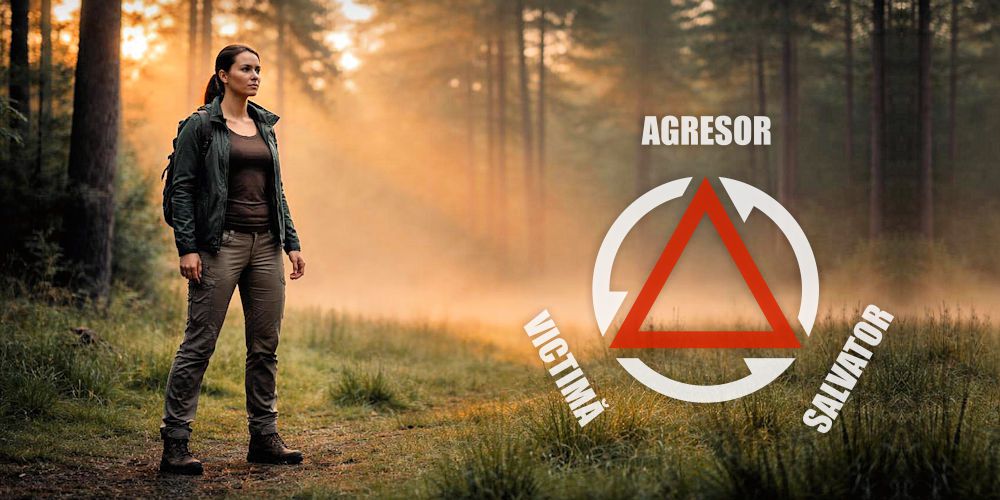
The way we approach power dynamics in our adult relationships fits a model well known in psychology: the Karpman Triangle — aggressor, victim, and rescuer.
The model is inherently dynamic — a person oscillates between all three roles, often without realizing it. The more strongly one extreme manifests outwardly, the more deeply another is experienced inwardly:
- An aggressor compensates through their actions for the pain they felt as a victim or as a rejected rescuer.
- A victim dreams of liberation through aggression, or manipulates those around them in order to receive help.
- A rescuer compensates outwardly for the fear of addressing their own pain, often expressing aggression in the act of combating aggressors.
This dynamic is part of how our brain works and cannot be entirely avoided. What we can do is learn to recognize the roles we are playing and limit the intensity of their consequences. We don't need to reject this dynamic — we need to accept it in order to control it.
The Three Profiles — and What Happens Under Pressure
Returning to the context of assault survival:
To defend herself effectively, a woman must first be willing to take on the role of rescuer toward herself — and then, if necessary, the role of aggressor toward the person attacking her.
The motivation to do so reflects exactly where she stands within the Karpman Triangle.
1) The woman strongly anchored in the Aggressor role will immediately engage in confrontation — because dominating the situation is her only strategy. The downside: she will unnecessarily escalate situations that could have been defused. She will be in a constant state of conflict, which will never bring her the happiness and acceptance she craves deep down. And when the aggressor overpowers her, the new pain will reinforce the pattern even further.
2) The woman strongly anchored in the Victim role will try to stop the aggressor by showing how much she is suffering — or will wait for someone outside to intervene. Some aggressors will stop, but most will take advantage or escalate. She will often manipulate emotionally to activate the rescuers around her. This is arguably the most disadvantageous position, because it depends entirely on other people.
3) The woman strongly anchored in the Rescuer role will quickly intervene for others, but will be unable to fight for herself. The irony is that her mode of action is also aggression — which she does not acknowledge, seeing herself as a peaceful person. This denial creates two major problems: she tends to escalate situations, and she cannot act in her own interest. The more fiercely she fights for others, the greater her inner suffering toward herself.
What is interesting is that we can manifest different roles in different contexts. We may be victims at work, aggressors at home, and rescuers among friends. Or we begin an argument from a victim's position and at some point "snap" and shift into the aggressor role. Or we start by being aggressive, and when the other person responds firmly, we switch into the victim role. The roles themselves are not the problem — what becomes problematic is experiencing them at too high an intensity, losing control in the process, and applying them in the wrong contexts.
What Does This Mean for You?
Changing the motivation to respond to aggression is a complex, long-term process. It's not just about learning how to defend yourself or strike back — it's about rewriting the core programs through which you approach conflict. It's not about new knowledge, but about personality change. It's not only about how you respond to an attack from a stranger, but about how you interact with everyone in your life: family, colleagues, friends, acquaintances.
And — most importantly — about how you relate to yourself:
Do you feel you are worth defending? Are you willing to do whatever it takes to survive?
This is the aspect that sets my courses apart from all others: I address the emotional dimension of aggression — not only its effect on the victim, but the victim's readiness to act effectively. Any technique learned and any supporting tool become useless if misaligned emotional patterns block rational decisions. Under danger and stress, emotional patterns activate automatically — applying the strategy deeply embedded in the personality: aggressor, victim, or rescuer.
From Awareness to Real Transformation
Through my courses I help all people — women, men, and children — to understand their current tendencies, learn new strategies, and prepare emotionally to apply them. I'm not looking for students who are happy they completed something easy and entertaining — but women shaken enough by the experience to take the phenomenon of aggression far more seriously.
In shorter courses I lead exercises that stimulate emotional reactions and help participants adapt them — and students change without even realizing it. In longer courses, there is time for deeper discussions, awareness, and more profound change. My courses are open doors that students can choose to walk through — the more they attend, the further they go: greater awareness, more constructive patterns, stronger self-control.
If you want to work on these aspects in a safe and inclusive environment, with a friendly yet serious atmosphere —I invite you to participate in the next courses that I will teach. Subscribe to the news by e-mail to receive timely information about them, plus interesting articles about surviving aggression. You can also find us on Facebook, Youtube, TikTok and Instagram.
Stay aware and live safely!
László Pethő
Instructor, therapeut and mentor
First Krav-Maga instructor in România