The Wise Man's Lesson and the Chessboard: Your Progress Is More Powerful Than You Think
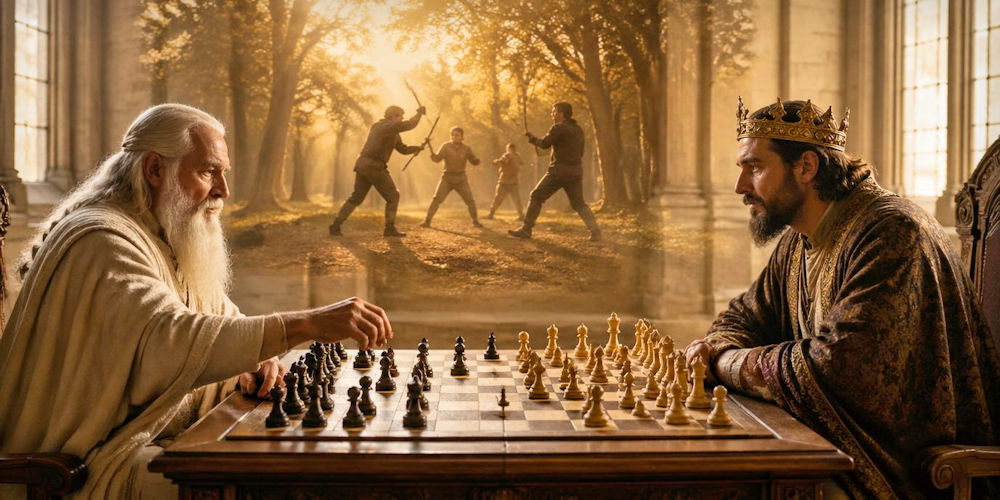
About 1,500 years ago, somewhere in India, a wise man brought before a king a new game — a game of military strategy that mimicked, on a small wooden board, the real dynamics of a battlefield. The game that evolved into what we know today as chess.
The king was deeply impressed. Not so much by the game itself, but by the lessons he discovered while playing:
- brute force does not always win
- the most modest resources can decide the outcome of a battle
- patience and strategy beat speed and impulsiveness.
At the end, he wanted to reward the wise man and asked what he desired. The wise man's answer seemed, at first glance, ridiculously modest.
"A single grain of rice on the first square of the board. And for each subsequent square, double the amount on the previous one."
The king smiled. It seemed like a joke. A grain of rice? Double on each square? What a trivial price for such a valuable lesson.
The court mathematicians began to calculate. And the king's smile quickly faded.
When "little by little" becomes unimaginable
The first numbers do indeed seem insignificant: 1, 2, 4, 8, 16, 32, 64, 128, 256, 512. By the tenth square we reach 512 grains of rice — just a few spoonfuls. By the fifteenth square, roughly one kilogram. Nothing spectacular.
But on the 64th square — the last on the chessboard — the total would be 461 billion tonnes of rice. And if we add all squares from first to last, we reach nearly 920 billion tonnes.
Of course, the king could not pay. At current global production levels in 2025, it would take humanity 1,650 years to produce that amount. But that was precisely the lesson: the wise man did not want the rice. He wanted to demonstrate something about the nature of progressive growth — that what seems insignificant at the beginning can become, through repetition and accumulation, inconceivable.
The two lessons behind the game
This story contains, in fact, two principles that I consider fundamental — not just for chess or for kingdoms, but for any field in which you want to develop, including self-defense.
The first principle: no matter how powerful a major piece is, the game is lost without the support of the pawns. The queen can control the board, the rooks can dominate the columns, the knight can leap over other pieces, the bishops can charge along the diagonals — but a king without pawns in front of him is exposed and vulnerable. The "powerful" pieces are impressive — but they depend on the foundation.
The second principle: no matter how small a repeated action seems, its cumulative effect can surpass any single effort. A grain of rice doubled 64 times exceeds all the rice ever produced by humanity. A skill practiced hundreds of times becomes the reflex that saves your life.
How this translates into real self-defense
When people come to my first Krav-Maga course, many look at their own body and think in terms of the "powerful" pieces: physical strength, stature, athletic condition, perhaps experience in combat sports. Or conversely — they see the absence of these as an insurmountable disadvantage.
But in real self-defense, the pawns are something else entirely:
- situational awareness — the ability to recognize risk before it becomes danger
- mental clarity in moments of stress, when most people freeze
- a few simple movements, practiced until they become reflexes, that work regardless of physical strength or the size of the attacker.
Large muscles are welcome. Good physical condition helps. But without these "pawns" — without mental and technical foundation — even the most impressive physical resources become vulnerable in the critical moment.
And now comes the second principle — the one I see most often ignored:
- You don't need to become invincible tomorrow. It is neither possible nor necessary. Progress in Krav-Maga — as in any serious discipline — happens through steps that initially seem small and insufficient. The first session gives you a few ideas and a few movements. You may not feel like you've gained much. The second session consolidates them and adds others. The third begins to connect them.
- At some point — and you cannot predict exactly when — something happens. A reflex appears where before there was panic. A decision is made where before there was a block. Not because you have become someone else, but because you have doubled, and doubled again, and doubled again — until the accumulation has crossed a threshold.
Why even "a little" matters
There is an objection I hear often, especially from people who came to one or two courses and then stopped: "I don't know if I've progressed enough. I don't feel like what I've learned is sufficient."
These are legitimate feelings. But they deserve an honest look at the real situation:
Compared to someone with no preparation at all, even minimal Krav-Maga training already places you at an advantage over the vast majority of potential attackers. Most of the time, attackers themselves have no useful training either — they rely precisely on the victim's lack of reaction and on paralysis. On the fact that they can impose themselves through force, aggression, and manipulation — the "powerful pieces" on the chessboard.
Yes, there will always be people better prepared than you. But the question is not whether you are the best. The question is: do you prefer to have almost no chance, or do you prefer to have a real one? In most situations, do you prefer viable options or do you prefer to rely on luck?
Every level of preparation statistically changes your odds. From 10% to 30%. From 30% to 60%. This is not about guarantees — there are no guarantees in real situations. It is about probabilities. And probabilities are built grain by grain, session by session, year by year.
What a camp offers that a regular course cannot
A weekend course gives you a starting point. A series of monthly courses gives you progress. But a 7-day camp does something different: it gives you real, rapid transformation.
You have enough time to practice until a movement is no longer something you "know" — but something you do without thinking. Time to understand not just the technique, but the context in which it works. Time to work with fear and stress, in controlled conditions, until your response becomes different.
In the Krav-Maga nature camps on July 5–11 and August 16–22, that is exactly what we do: 5 hours of daily training for 7 consecutive days. Not to exhaust you. But because intensive accumulation produces a qualitative leap that individual courses cannot.
And we do it in nature, with meals cooked together, evenings around the campfire, and a small group — a maximum of 16 people — sharing the same experience. Because sometimes the most important thing you learn is not a technique. It is that you can. That you are more capable than you believed.
The first grain of rice
The wise man in the story asked for a single grain of rice on the first square. Not twenty. Not a hundred. One.
Perhaps your first "grain of rice" is reading the camp description. Or filling in the registration form. Or sending an email with a question. Small steps that seem insignificant in the moment you take them.
But it is precisely from these steps that everything that matters is built.
I invite you to participate in the next courses that I will teach. To find out about them early, subscribe to our email newsletter. You will also receive interesting articles about surviving aggression. You can also find us on Facebook, Youtube, TikTok and Instagram.
The first grain of rice is all that is needed right now.
Stay aware and live safely!
László Pethő
Instructor, therapist and mentor
First Krav-Maga instructor in Romania