I Don't Know How to Fight — I'm Only Prepared to Neutralize
The same principles govern every conflict — whether it's an argument with your partner, tension with a colleague, a struggle with your own thoughts, or a physical assault on the street. Only the intensity differs.
What you learn about yourself in a real physical conflict — under pressure, with no time to think — applies identically to any other form of conflict. This is why physical training matters even for someone who will never experience a physical assault: it's the place where principles can no longer stay mere ideas, but are tested and turned into reflexes.
People in general don't know or understand violence — neither its psychological and emotional side, nor its physical side. Most "victims" are lucky that most aggressors are just as ignorant, or don't intend to escalate. But that's not a strategy, it's just luck.
Why is it vital to understand violence — even if your life is peaceful and free of physical conflict?
- Only then can you recognize it immediately, both in others and in yourself. Only once you've recognized it can you choose the right action — whether that means a punch or a raised tone in a conversation.
- Since you know any conflict can spiral rapidly, your main concern becomes avoiding or defusing it, not winning it.
- If you can't avoid the conflict, you have the mental, emotional, and — when needed — physical capacity to stop it as quickly as possible.
What actually happens, regardless of the type of conflict?
- Someone "attacks" you mildly — a remark, a shove, an unfair accusation. You react instinctively, going into defense mode. Depending on your patterns, that defense is either flight or fight.
- Flight is sometimes the best choice. Other times, though, it simply means adopting the role of perpetual victim, because it stops neither the external aggression nor the internal conflict.
- Fighting is useful sometimes, but far too often, entering it immediately escalates the aggression — because both sides try to dominate each other. That can quickly lead to an extreme form of conflict, emotional or physical.
The big problem with any real conflict, physical or emotional: it can escalate extremely fast, and you can never know beforehand how it will end. The person attacked never truly wins — they always lose something: time, emotional energy, relationships, sometimes more.
A Story That Shows What Real Competence Looks Like
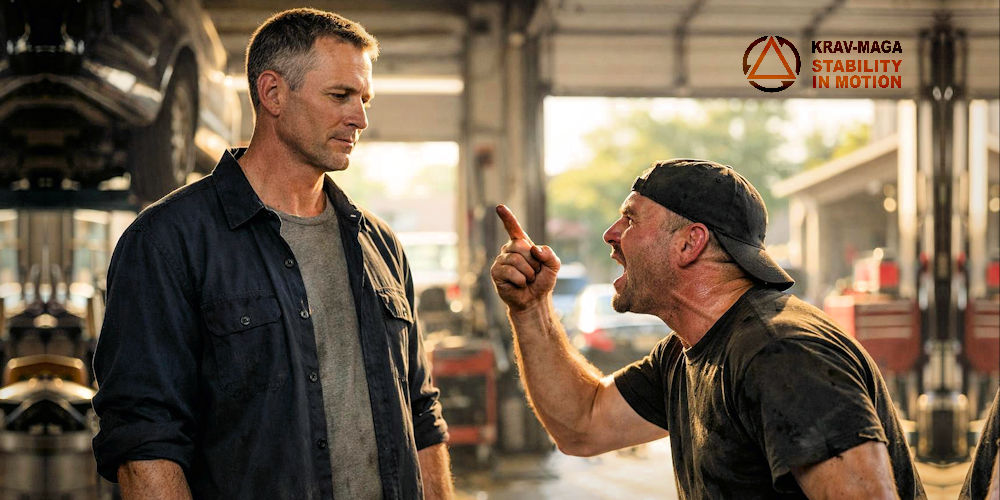
I once worked alongside a former Navy SEAL. He was an auto mechanic at the same shop as me. Quiet, polite, with an extremely dry sense of humor.
One afternoon, an angry customer stormed into the shop to complain about a repair he felt hadn't been done properly. He went straight up to John and started shouting in his face, shoving him in the chest. John, considerably taller than him, simply stood there, unmoving. He said nothing. He didn't react in any visible way. The customer, clearly unsettled by the complete absence of any response, grew increasingly uncomfortable and eventually walked out of the building.
I couldn't help myself. I went over to John and asked him: why didn't you just wipe the floor with that guy?
He answered quietly: 'I realized I don't really know how to fight anymore. The only thing I could have done was kill him. I just don't know how to fight anymore.'
Then he turned around and went straight back to work, as if nothing had happened.
What stopped John wasn't fear. It was clarity about the consequences of his own competence. That's exactly what serious training means, regardless of the field: it doesn't give you more reasons to react, it gives you more clarity about when and why not to.
My Approach
In my personal life, and in what I teach in my courses (Krav-Maga and survival of real aggression), I apply the same approach, whether we're talking about a physical or an emotional conflict: I avoid conflict as much as possible.
Can I respond harshly to someone who provokes me verbally? Yes. Do I have any guarantee the situation won't escalate? No.
Can I slap someone who insults me? Yes. Do I have any guarantee they won't slap me back? No.
The question is never what I can or can't do — it's clear I can act very harshly, both verbally and physically. The question is what the consequence of my choice will be.
In theory, I have 3 options:
- try to avoid or defuse the situation
- respond moderately, to try to stop the aggressor
- neutralize quickly and efficiently
Most people choose the second option, answering aggression with aggression. Sometimes it works — on weak aggressors or ones without strong motivation. Other times, though, it turns into a fight where both sides lose, immediately or in the long run.
I almost always choose the first option: to leave or defuse. It ends the fastest, with minimal risks and consequences — and this holds equally true in a heated argument or a physical confrontation.
If I can't do that, or it isn't viable, in the case of a real physical assault I go straight to neutralizing: I act physically, directly, quickly, firmly, to take away the aggressor's ability to hurt me further. That means multiple strikes to sensitive areas, causing pain, fear, and injury. It's not a fight — no contest of who wins. It's my action and his reaction. I'm in control; he responds.
It's the last option, because once started, it has to be carried through to the end — until the aggressor no longer wants to, or no longer can, hurt me. Not knowing the aggressor, I don't know when he'll stop. Which means that when I start neutralizing, I have to be mentally and emotionally prepared for the worst possible consequence. If I'm not prepared for that, I won't even give him a slap.
Of course I don't want to hurt anyone, or face legal complications after hurting someone who truly deserved it — that's why I avoid conflict of any kind as much as possible. But I'm prepared to go all the way if my safety is genuinely at risk.
I'm a survivor who wants a harmonious life, not a fighter looking for conflicts to win.
Your Approach
What role do you step into when you're provoked — at work, at home, with yourself: victim, fighter, or survivor?
Many people I've talked to have told me they have no self-defense training whatsoever, yet they're confident that when they're physically attacked, they'll manage. Their belief is that even though right now — calm and with time to think — they don't know what they'd do, under stress and in split seconds they'll instantly have the necessary solutions and resources.
Reality shows the opposite: under stress, you don't have more capacity — you have far less than what you've practiced in simple scenarios and peaceful contexts. Sometimes you freeze completely. Other times you react impulsively, ineffectively, or too aggressively.
Physical training that simulates real aggression is the only place where you find the real answer, not the one you imagined. In my courses, I combine clear explanation with progressive practice, from simple movements all the way to the chaos of a real attack.
Stay aware and live safely! Subscribe to email updates to find out about upcoming courses and articles.
László Pethő
Instructor, therapist and mentor
Romania's first Krav-Maga instructor