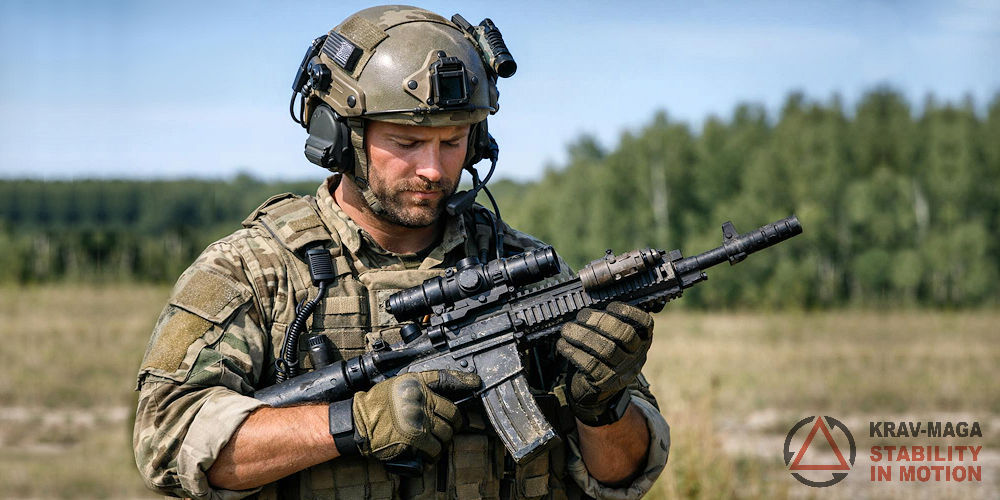
Special Forces Don't Need the Best Weapons — They Need the Most Common Ones
I recently watched a presentation on a new firearms technology: high-velocity ammunition. These rounds, thanks to their higher speed, can travel farther and penetrate better-protected targets. However, achieving this performance requires a cartridge with greater explosive power — which in turn demands specialized weapons capable of absorbing the additional forces and wear.
Both this type of ammunition and the weapons capable of using it already exist. The manufacturing technologies are new and costly, so mass replacement of current weapons is out of the question. But that wouldn't be an obstacle for special forces, who require small quantities and have no budget restrictions. Nevertheless, decision-makers rejected the adoption of the new technology, preferring to stick with the ammunition — and implicitly the weapons — used by the majority of military forces.
At first glance, the decision seems wrong: why not take advantage of the latest technological advancement if you can afford it? The answer is the very principle that underlies the effectiveness of special forces: they don't need the best weapons — they need the most common ones.
Special forces plan their missions carefully, but they must always be prepared for the unexpected. They carry a lot of equipment, so ammunition must be carefully estimated. And if it runs out, they cannot always rely on supply channels. They must use the resources available in their operating environment — ammunition from other military units, or even ammunition recovered from the enemy. Therefore, it is more advantageous to carry a weapon that accepts a widely-used caliber than one optimized for a niche cartridge.
The same principle applies to the selection of special forces personnel: they don't need the physically strongest, but the most resilient. People who don't fall apart when they fail, but look for new solutions. People who don't take unnecessary risks, yet don't give up when things get hard. People who must deliver results even when exhausted or injured.
The Same Principle, in Every Conflict
I wrote about weapons and special forces personnel because this logic extends far beyond the battlefield. Resilience — the capacity to not fall apart when things go wrong and to improvise in order to regain the advantage — is precisely what determines how we handle any conflict.
Not just physical aggression. An argument with someone close to us, emotional pressure, inner conflict — all follow the same structure: a moment of destabilization, a quick choice, and either the capacity or the inability to remain functional under pressure. Assuming the role of a victim or a survivor.
The person who recovers quickly from failure in the training hall is the same person who doesn't freeze when a difficult conversation takes an unexpected turn. The one who doesn't focus on what others should do, but on what they themselves can do concretely to improve their situation. The one who chooses for themselves, instead of depending entirely on others.
The principle is identical. The context changes, the intensity changes — the structure remains.
My Approach trough Krav-Maga
It means nothing to me if someone shows me a head kick, a punch that breaks bricks, a lock, or an elaborate sequence of movements. They're impressive, but they require years of training to master, a conditioned body, and a clear mind. What works in competitions or demonstrations will typically fail under the conditions of real aggression: surprise, no rules, a stronger aggressor, multiple attackers, weapons.
It means nothing to me if someone shows me how strong, how fast, or how well they can endure fatigue and strikes. All of that becomes irrelevant when you're exhausted, injured, or ill and — especially — when the aggressor is stronger or more capable than you.
This is why physical training in Krav-Maga is not an end in itself. It is a laboratory.
The only environment where principles cannot be faked — because under real physical pressure, your inner state surfaces regardless of what you believe about yourself. You can intellectually understand what it means to stay calm under pressure in a therapy session or a self development workshop. But embodying it is something else entirely — and it is built only through varied repetition, in conditions that don't allow you to hide.
My goal as an instructor is not to develop the perfect fighter, nor to teach the ultimate technique. My goal is to develop a resilient character: one that recovers quickly from failure, improvises rapidly to regain the advantage, and knows how to recognize, de-escalate, and — when there is no other option — stop aggression. In whatever form it takes: emotional or physical.
A community cannot live in peace without the competence to properly manage aggression — within itself and in the relationships between people.
Peace is not the absence of conflict. It is the capacity to move through it without losing yourself.
Just as a special forces soldier is not an Olympic shooting athlete, a Krav-Maga practitioner is not an athlete fighting in a ring.
Athletes train for performance, within rules and controlled conditions. We train for life — where rules are absent, conditions are unpredictable, and the stakes are real.
Stay aware and live safely! Subscribe to email updates to find out about upcoming courses and articles.
László Pethő
Instructor, therapist and mentor
Romania's first Krav-Maga instructor