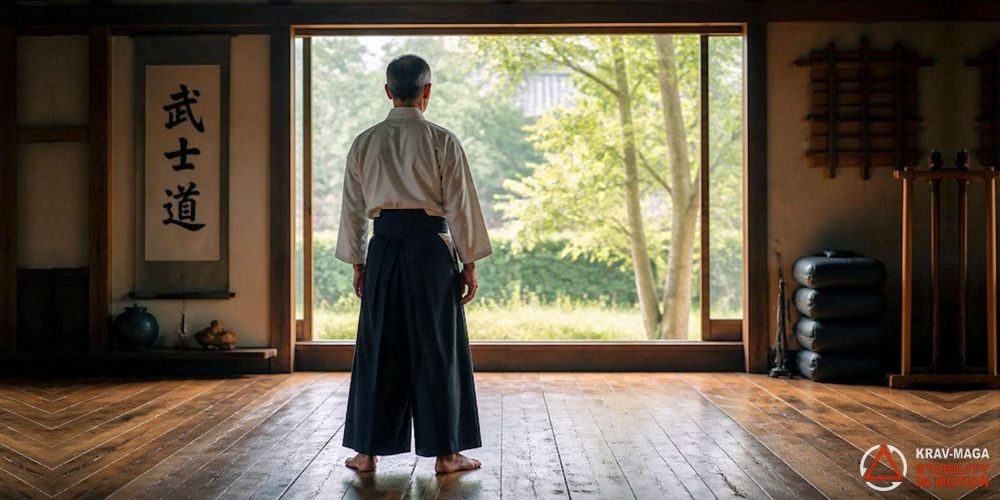
I Follow Tradition for Efficiency, Not for Tradition's Sake
There is a fundamental difference between knowing the origin of something and understanding the purpose for which it was created. In martial arts, this difference is often ignored. Tradition becomes an end in itself, techniques are passed on identically from one generation to the next, and the question "why?" gradually disappears under the weight of "this is how it's done."
I started from exactly that place. And it took me over fifteen years to understand that this blind fidelity to form was precisely what prevented me from truly honoring the spirit of what I was teaching.
What It Means to Learn from the Source
I was fortunate to learn Krav-Maga thoroughly from Yaron, a direct student of Imi Lichtenfeld — the creator of Krav-Maga — and from Onn, one of his students, who trained under Imi's close supervision. Not fragments picked up from videos or weekend courses, but complete and original Krav-Maga, as a martial art.
I heard stories about Imi — as an instructor, a military figure, and a human being — from people who spent many years alongside him and knew him well. About how he created Krav-Maga and the purpose he pursued. About the instructors he trained and their subsequent evolution. About the power struggles and the divergence of approaches, beginning during Imi's lifetime and continuing after his death. Not from online articles or stories distorted by dozens of intermediary storytellers.
This solid foundation gave me something essential: I understood Krav-Maga from the inside. I shaped myself around Krav-Maga — I did not shape Krav-Maga around me. And that is a distinction many instructors never make.
Fifteen Years of Teaching — and an Uncomfortable Question
For nearly fifteen years I taught Krav-Maga as a martial art, following the colored belt curriculum, in courses spread over multiple years. I absorbed hundreds of techniques and taught them as correctly as I could, with the conviction that fidelity to form was synonymous with teaching quality.
The principle was deeply rooted in me, carried over from previous training in other martial arts: tradition must be continued through identical transmission. Change meant betrayal. Adaptation meant dilution.
Then I began teaching intensive courses in parallel. Two hours, three hours, six hours. Two days, four days, six days. Courses limited in time and, implicitly, in the number of techniques I could cover. And it was precisely this constraint that forced me to ask a question I had never taken seriously enough before:
If I can only teach a few techniques, which ones truly matter?
The answer to that question changed everything that followed.
When Less Becomes More
I realized I needed to prioritize teaching an extremely small set of techniques and repeat them in a different way — so that, in the end, students would leave with real skills, not a false impression of effectiveness. The difference between the two is enormous and, at the same time, hard to see from the inside: you can walk out of a course convinced you know how to defend yourself, without ever having been genuinely tested.
The most important thing I understood during this period is that my role as an instructor is not to teach a tradition, but to build skills. Tradition must remain the necessary foundation — not the final goal.
And so I began to teach differently.
What Concretely Changed in the Training Room
The first step was elimination. I removed techniques that existed only for spectacle or for demonstrating physical condition. Beautiful, impressive, useless in the context of a real aggression.
Then I made small adjustments to certain techniques, to make them applicable by more types of people — not only those with a favorable physical build or previously formed reflexes. A technique that only a trained man can apply is not a survival technique. It is a contact sport technique with a different label.
I placed more emphasis on varied repetition — not on quantity. A few techniques, practiced in hundreds of different contexts, build a real reflex. Dozens of techniques, practiced once or twice, build nothing usable under stress.
I introduced exercises with random attacks and improvised responses — situations where the student does not know in advance what is coming and must react, not execute a memorized script. And I introduced scenarios with no winning outcome, only survival for as long as possible with as little cost as possible. Because on the street there are no rounds, no referees, and no rules.
Perhaps most importantly: I placed more emphasis on recovering from failure than on the perfect execution of a technique.
On the street, winning does not matter. Nobody grades you on the correctness of your execution. The only thing that matters is getting away as quickly as possible, with as little damage as possible.
The Spirit, Not the Ashes
There is a saying that has stayed with me: "Do not perpetuate the ashes, but the spirit."
The ashes are the fixed forms, the techniques preserved identically because "that is how they were passed down," the curricula built to demonstrate continuity rather than effectiveness. The spirit is something else: it is Imi Lichtenfeld's original intention, who created Krav-Maga for ordinary people, not for competitive athletes. For real situations, not controlled competitions. For survival, not spectacle.
Imi did not create a rigid system. He created a principle: simple, efficient, applicable by anyone, in any condition.
Anything that moves away from this principle — no matter how impressive it looks — betrays the original spirit of Krav-Maga, even if it carries its name.
I no longer teach tradition for tradition's sake. I teach in the original spirit of Krav-Maga, in the direction Imi Lichtenfeld envisioned: Krav-Maga for real safety and authentic personal development. For a life in which you know you can handle what comes — not because you memorized a list of techniques, but because you went through difficult situations and came out the other side.
What This Means for Those Who Come to Train
I now have over 23 years of experience in learning and teaching Krav-Maga.
If you come to my courses expecting to learn dozens of spectacular techniques you can demonstrate at a party, you will be disappointed. That is not the goal.
If you come to build a real capacity to handle difficult situations — physical, mental, emotional — you will find exactly what you are looking for. You will work more on fewer techniques. You will be placed in uncomfortable situations, sometimes with no obvious way out. You will make mistakes, be corrected, and repeat. And in the end, you will leave not with a certificate and a set of memorized movements, but with something far more valuable: the certainty that you know what to do when it truly matters.
This is the Krav-Maga I teach. This is the Krav-Maga Imi envisioned.
Invitation
I invite you to participate in the next courses that I will teach. To find out about them early, subscribe to our email newsletter. You will also receive interesting articles about surviving aggression. You can also find us on Facebook, Youtube, TikTok and Instagram.
Stay aware and live safely!
László Pethő
Instructor, therapist and mentor
Romania's first Krav-Maga instructor