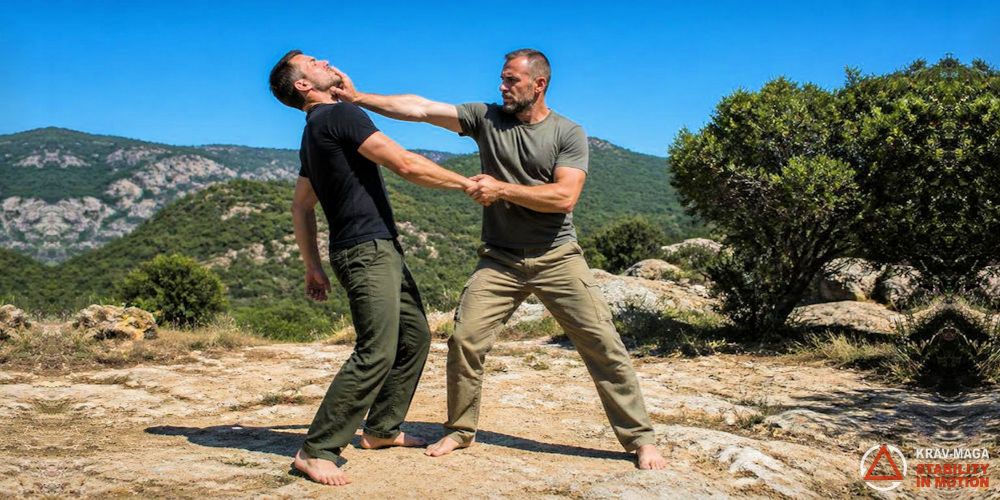
Why It Is Not Enough for a Technique to Work
At one of my recent courses, a student asked whether he could continue a technique with an additional manipulation of the aggressor's arm. I asked him to show me what he had in mind. The movement was logical and reasonably well executed. And yet I told him I did not recommend forming it as a reflex.
His question was simple: why not, if it works?
The answer to that question contains, in fact, one of the most important lessons I teach.
It Works — But Under What Conditions?
The technique my student wanted to add would have worked perfectly within a narrow set of conditions: an aggressor of similar build, sufficiently mobile and relaxed, who does not actively counter in the first fractions of a second. Against a more massive, more rigid aggressor, or one who reacts differently, the movement would not have worked. And while the student was trying to force it, the aggressor would have had time to act.
This is the central problem with many techniques that circulate in martial arts and even in some systems that present themselves as Krav-Maga: they work, but under conditions a real aggressor will not respect.
If you watch the demonstrations of most instructors, you will notice a consistent pattern: the demonstration partner is almost always smaller, weaker, less technical, and perfectly cooperative. The attack comes exactly as needed, at the right speed, from the ideal angle. The demonstration goes flawlessly. The argument seems irrefutable.
Now change just one parameter: an aggressor twenty kilograms heavier, fighting by entirely different rules, offering even minimal resistance. And you will see that most demonstrations fail. Not because the technique is wrong in absolute terms, but because its range of applicability is far smaller than initially presented.
The Reflex Does Not Ask — It Executes
There is a fundamental principle of training under stress that any serious preparation system must accept: what you train becomes reflex. Under pressure — adrenaline, fear, surprise, pain — you have neither the time nor the cognitive capacity to analyze the situation step by step. The body executes what it has repeated most often.
This is, simultaneously, the greatest power of serious training and the greatest danger of superficial training.
If you have repeated an effective technique for hundreds of hours, you will apply it correctly and quickly precisely in the moments when your conscious mind is overwhelmed. If you have repeated a technique that only works under ideal conditions, you will apply it under conditions that are not ideal — and you will fail precisely when you cannot afford to.
This is why the standard I apply to every technique I teach is simple and non-negotiable: can it be applied with real chances of success by the weakest person in the group against the strongest man in the group? If the answer is yes, the technique deserves to become a reflex. If not, it may be useful in certain contexts and may be worth knowing — but not trained to automatism, and not without clearly identifying its limitations.
Contact Sport versus Surviving Real Aggression
There is a frequent confusion between preparation for contact sport and preparation for surviving real aggression. The two are not the same thing. They are not even close.
Contact sports — however tough some of them may be — operate with clear rules and limitations. Competitors fight in optimal physical condition, against opponents selected by weight and experience criteria, with known attacks, and with referees who intervene when the situation becomes dangerous. It is a fight between equals, under controlled conditions, with the goal of winning a match.
Real aggression works completely differently. The aggressor will not be the same weight as you. He will not respect rules. He will not attack from a predictable angle. He will not necessarily be alone. And he will not stop the attack because you correctly applied a level-two technique from your martial arts curriculum. And in many cases he will be accompanied by friends or will be armed.
I am exclusively interested in this second scenario. The efficiency I pursue is built for aggressors who are larger, stronger, possibly armed, possibly accompanied. The only rule is: can you stop the aggressor before he seriously hurts you? Any technique or approach that does not satisfactorily answer this question, under realistic conditions, does not deserve to become part of your reflexes.
The Number of Techniques Is Not a Virtue
There is a natural temptation, both for instructors and for students, to associate the value of a system with the number of techniques it contains. More techniques means more preparation, more knowledge, more value. This logic is, in the context of surviving real aggression, completely inverted.
A saying I quote frequently summarizes the opposite principle perfectly: "Fear the one who has practiced one technique a thousand times, not the one who has practiced a thousand techniques once." With one essential condition: that the technique in question is suited to the intended context.
A technique repeated a thousand times in varied and realistic contexts becomes an automatic, fast, efficient response — applicable even when you are surprised, frightened, or already hit. A thousand techniques repeated once each remain information stored somewhere in memory — completely inaccessible in the moment when the body switches to survival mode and the conscious mind withdraws.
After over 23 years of teaching and thousands of students, I have reached a clear conclusion: since I have limited teaching time, I prefer to invest it in maximum efficiency. A few essential techniques, trained intensively, in as varied and realistic contexts as possible. Not dozens of techniques covered superficially, with the illusion of complete preparation.
What This Means in Practice
Concretely, my approach involves a few clear principles:
- Simplicity is not a limitation — it is a condition. A simple technique, applicable in many contexts, is worth more than ten sophisticated techniques with narrow applicability. The brain and body under stress seek the simplest available response. If that response is also the most efficient, you are prepared. If it is not, you are in danger.
- Training variability is essential. It is not enough to repeat a technique always in the same context, with the same partner, from the same angle. Real aggressions do not follow scripts. Training must include random attacks, improvised responses, and situations with no perfect way out — only a less costly one.
- Failure is part of training, not an accident to be avoided. Scenarios in which you cannot win, only survive as long as possible, are just as valuable as those in which the technique goes perfectly. They build real resilience — the capacity to keep functioning even when things do not go according to plan.
- The limitations of techniques must be taught explicitly. Every technique I teach comes together with the contexts in which it works and those in which it does not. A student who knows the limits of a tool will use it correctly. One who believes their tool works in any situation will make costly mistakes precisely in critical moments.
Why It Matters Who You Learn From
These principles did not emerge from theory. They emerged from tens of thousands of hours of training, from thousands of students with completely different levels and physical builds, and from a solid foundation built through direct learning from authentic sources of original Krav-Maga.
I learned Krav-Maga completely and in its original form — as a martial art, not as a simplified military package or a spectator sport. This foundation allows me to understand what can be simplified without losing real effectiveness, and what simplification actually destroys the essence of a principle. Not all modifications are improvements. But not all traditions are efficiency either.
The difference between an instructor who adapts from deep understanding and one who modifies out of ignorance or a desire to impress is enormous — even if, viewed from the outside, the results may appear similar at first glance.
Invitation
I invite you to participate in the next courses that I will teach. To find out about them early, subscribe to our email newsletter. You will also receive interesting articles about surviving aggression. You can also find us on Facebook, Youtube, TikTok and Instagram.
Stay aware and live safely!
László Pethő
Instructor, therapist and mentor
Romania's first Krav-Maga instructor