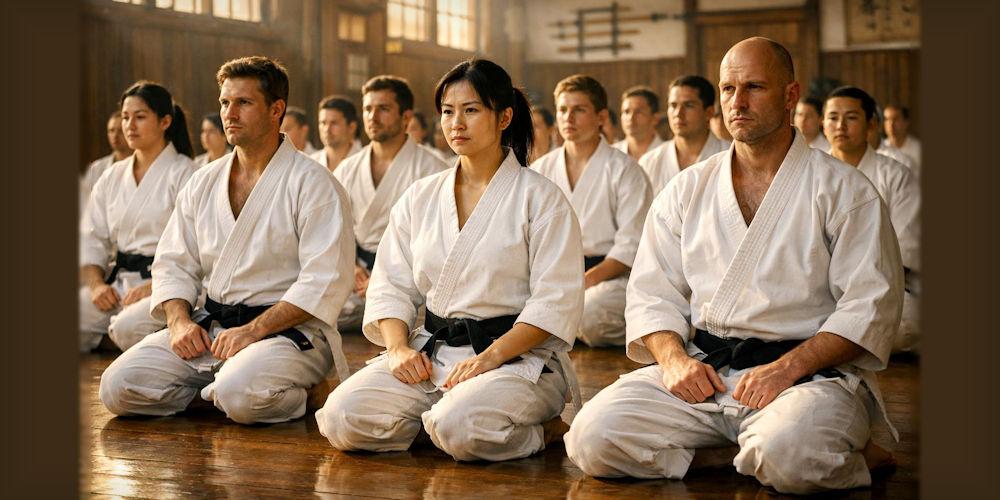
38 years ago, I began my journey through martial arts. I was training Shotokan in a large hall, with over 60 students at every session. There was a rule everyone knew: the last to enter the hall was always the instructor. And whoever saw him first had to shout the alignment command, so everyone else would immediately line up in rows and columns, ready for the bow.
On top of that, every student who entered the hall had to bow to the room. It was more than a gesture of courtesy. It was a threshold. A psychological crossing from the world outside into what was about to happen within.
One day, however, the instructor walked in and no one noticed. Students were busy with their own warm-up or talking among themselves. He waited a few moments. Nothing. In the end, he gave the command himself. We lined up quickly, sat in seiza, and bowed. But instead of rising and beginning training, the instructor told us to stay down.
He explained that the training hall is similar to a battlefield. That the bow upon entering was not a formality, but a conscious transition from the mindset of everyday life to that of a warrior. That it was not acceptable for anyone — especially the advanced students closest to the entrance — to fail to notice someone new entering the hall. And that he would help us integrate this principle.
The floor was hard under our bare feet. After a few minutes, the discomfort had already set in. Then the instructor gave the command: alternating front punches, counted out loud. We began to punch. With each strike, the body rotated slightly — and those rotations pressed and dragged the soles of our feet against the floor. Pressure. Friction. Burning.
The instructor only stopped counting to remind us of one thing: punch with full commitment. But the more we committed, the wider the rotations, and the more intense the pain. The skin on the soles of our feet was crushed and scraped against the floor.
And that is when the real dilemma appeared — not in the feet, but in the mind:
Do I punch lighter, to protect myself? Or do I give everything I have, ignoring the pain?
Do I resist this "punishment"? Or do I accept the exercise as a lesson?
I chose to trust the instructor. If he had decided this, it was because he had a reason. Yes, it hurt and I did not like it. Yes, I could feel the skin scraping off. But I chose to commit fully. And the more it hurt, the harder I punched.
The pain had become fuel, not a brake.
After many hundreds of punches, the instructor stopped.
We rose slowly, with numb feet. Most of us had bleeding wounds on our soles. But our eyes said something other than pain. They said we had survived the challenge. That we had chosen to stay present and committed when it would have been easier to pull back or simply go through the motions.
Training continued normally, without reproach, without any further mention of what had happened. And yet, from that day on, it never happened again that the instructor walked into the hall and was not noticed immediately.
Not because we feared the consequences. But because we had understood something about what it truly means to be present.
A few days ago, I was sharing this story with my current students. At the end, one of them raised his hand and asked: "But what was the point of injuring yourselves punching in seiza?"
The question was sincere. And it deserves a sincere answer.
The wounds on our feet were not deep or dangerous. The numbness passed in a few minutes. The skin healed within a few days. That was not what the exercise was about.
It was about the moment when pain arrives and the mind offers you an escape. Punch lighter. It's not worth it. No one can see how hard you're hitting anyway. And you have to decide: who are you in that moment? The person who quietly gives up, or the person who remains true to themselves — even when no one is watching, even when it hurts?
That is what martial arts truly build — not just muscles, not just techniques, but above all character. Will. Perseverance. The capacity to remain functional and make sound decisions precisely when everything becomes uncomfortable.
There are many brave people in times of peace. The question is who stays brave when real hardship arrives — when you are exhausted, when it hurts, when the situation is out of control. And the answer to that question is not found in theory. It is found in practice. In those moments when you chose to stay present and committed, even though you could have walked away.
I have known for a long time that I can push through pain when I have a purpose important enough. I know I can mobilize myself even when I am exhausted or ill. I know I can access resources others cannot even imagine — not because I am special, but because I have repeatedly entered contexts that truly challenged me and proven to myself, every time, that I could come through them.
Each of us knows ourselves only to the level of the challenges we have taken on. No more, no less. And very often we believe we have certain limitations only because we never had someone we could trust — someone to guide us further, into the territory we are afraid of.
What about you? How much and how intensely have you challenged yourself in your life?
How often have let yourself guided by someone with more experience?
If the honest answer is "not enough" — and if you want to change that — I invite you to my courses. Not to get injured. But to enter real contexts, with respect and safety, that will show you who you truly are under pressure.
So that you know — not just assume — that you can survive great hardships. And so that you become the person those around you can rely on when they reach their own limits.
Stay aware and live safely!
László Pethő
Instructor, therapist and mentor
Romania's first Krav-Maga instructor