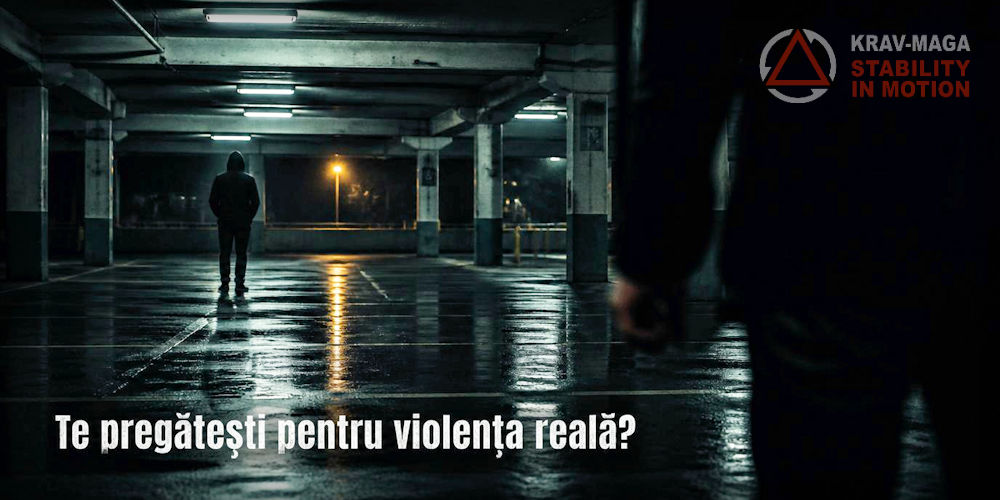
Your Dojo Isn't Preparing You for Real Violence — And Here's What You Should Do About It
I hear it from time to time: "I train or have trained in martial arts. I'm ready for real violence."
This belief is, in most cases, an illusion. A comfortable one — but a dangerous one. Regardless of which martial art or combat sport we're talking about.
Not because the training you've done is worthless. It is valuable. But there is a fundamental difference between being prepared to fight and being prepared to survive a real attack. That difference is not about technique. It's about principle.
Sport and self-defense are not the same thing
Martial arts, combat sports, and even many Krav-Maga courses share one thing in common: they train your response to an opponent similar to yourself, someone you are prepared to engage with.
Your sparring partner approaches. He prepares. He takes a stance. You prepare in a similar way. There is an implicit set of rules about what is and isn't allowed. There is a starting distance. There are weight, age, and skill categories. There is a referee, a stop, a "that's it."
Real violence doesn't work that way.
A real attack begins before you realize it has started. There is no greeting, no opposing stance, no rulebook. There is a person who has already decided to hurt you, who has chosen the moment, the place, and the method — and who acts at exactly the moment you are least prepared. He has chosen you as a victim precisely because he knows he has the upper hand in at least one way.
This is not a problem of technique. It is a problem of paradigm.
What most courses are missing
If you look at what is actually taught in the average training hall, you'll find heavy emphasis on technical execution and physical conditioning, with little attention to everything that happens before and after the confrontation.
- Pre-attack recognition. What does someone look like when they're about to hit you, versus someone who is simply verbally aggressive? There is a clear difference — there are specific signs: in the eyes, in body movement, in the distance they close toward you. If you can't read these signs, you're always one step behind.
- De-escalation. The best scenario is not the one where you win the confrontation. It's the one where the confrontation never happens. There are clear, tested strategies for reducing the tension of a situation without reaching physical contact. When do they work? When don't they? When does talking actually make things worse? These are questions with answers — and you won't find them in kata.
- The legal framework. You don't need to be a lawyer. But you need to understand the basic principles of legitimate self-defense: what constitutes a proportional response, where self-defense — that is, surviving the situation — ends and excess begins. A poorly calibrated reaction can cost you more than the attack itself.
- Real pressure. The strike that works perfectly on a cooperative partner, at the right distance, in good lighting — may not work at all when you're surprised, when your pulse is at 180 beats per minute, when someone has grabbed you by the collar and is screaming in your face. Training must introduce controlled chaos, not just the repetition of correct form.
Why Krav-Maga is different — and why even it is often poorly taught
Krav-Maga was designed precisely to fill these gaps. It is not a sport. It is not merely a fighting system, nor is it an art form. It is a pragmatic system, optimized for a single question: how do you survive a dangerous situation and get out of it as quickly as possible?
The core principles are simple and brutal: there are no rules, there are techniques that work under pressure, there is the objective of ending the confrontation before it escalates. That is why it includes the strikes other systems call "dirty" — strikes to vulnerable zones, distance-breaking techniques, releases from grips. They are not dirty. They are effective. They are banned in competition for exactly that reason.
The problem is that Krav-Maga has become popular. And popularity dilutes any system. Today there are Krav-Maga courses that are, in practice, "karate" with different branding. Techniques are taught, repetitions are done, real contact and chaotic scenarios are avoided — because chaos is uncomfortable, clients don't come back when pushed into genuinely stressful situations, and it's easier to sell precision than real preparation. And so the illusion of effectiveness is sold — in conditions completely unlike those of the training hall.
What authentic preparation for real violence looks like
I have been teaching self-defense — more precisely, preparation for surviving aggression — for over 23 years. I am the first certified Krav-Maga instructor in Romania, trained in the authentic system, Krav-Maga as a martial art. In all this time I have seen one constant: the people who train most seriously are not necessarily the most technically skilled. They are the ones who have internalized how real violence works — not how it looks in films or on training room floors.
Authentic preparation has several clear characteristics.
- It works with realistic scenarios, not textbook attacks. Nobody attacks you karate-style with a punch from two meters away, with a kiai and an arm frozen in the air. Real attacks are close, fast, and ugly. Training must reflect that.
- It includes progressive pressure. There is a difference between repeating a technique and executing it when someone is genuinely trying to control you. Feedback — pads, live resistance, scenarios with variables — is what transforms a technique from theory into reflex.
- It covers the entire process: from awareness and recognition, through de-escalation, to physical intervention and its consequences. Surviving an aggression does not begin when you are hit. It begins long before.
- It works explicitly with mental and emotional state. Under adrenaline, your brain functions differently. It loses access to fine motor movements, to complex decisions, to the procedural memory you built through training. What remains are reflexes and simplicity. That is why Krav-Maga techniques are simple by design — not because your opponent is simple, but because you, under pressure, need immediate access to what works.
- And perhaps most importantly: as a rule, you will be surprised. Even with good training, even with genuine awareness, real-world violence does not announce itself. The question is not whether you will be surprised. It is how quickly you recover from that surprise and bounce back from setbacks.
Before signing up for any course, ask yourself
- What is actually being trained there — clean techniques or scenarios that push you out of your comfort zone?
- Is there real contact, controlled pressure, intentional chaos — or mostly form correction and applause at the end?
- Is there discussion of what happens before and after physical contact — or does the course begin and end with strike combinations?
If the answers leave you with doubts, you are probably buying the comfort of feeling like you're doing something useful — not real preparation.
Authentic self-defense — preparation for survival, not for fighting — is not comfortable. It is not aesthetic. It does not produce colored belts and impressive demonstrations. It produces people who know how to read a situation, avoid it, and — when that is no longer possible — end it quickly and leave.
That is the difference. And it is worth knowing before you need it.
Invitation
I invite you to participate in the next courses that I will teach. To find out about them early, subscribe to our email newsletter. You will also receive interesting articles about surviving aggression. You can also find us on Facebook, Youtube, TikTok and Instagram.
Stay aware and live safely!
László Pethő
Instructor, therapist and mentor
First Krav-Maga instructor in Romania